
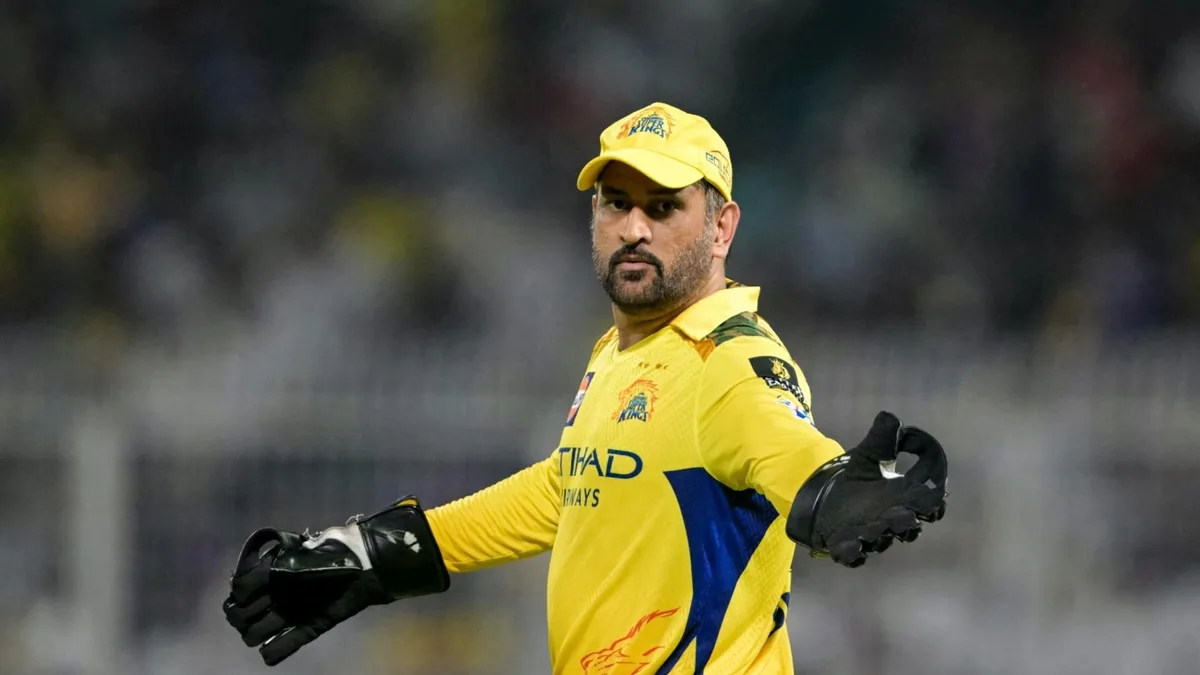
MS Dhoni has finally bid adieu after collecting immense adulation from his fans, but did the hero supersede the cricketer by the end?
There is something about MS Dhoni’s latest Instagram video confirming his retirement that is difficult to put into words. Perhaps it is the pictures, picked from an old-world photo album, or perhaps it is the rawness of an edit that looks like it was put together on the now almost extinct PowerPoint, with little thought given to transitions or presentation. It is not a compilation of sixes, trophies and the many occasions on which he made the impossible look routine. Instead, there are faces, friendships, dressing-room memories and people he has loved and lost along the way. A life, in little fragments, collected as he passed through the sport. It is difficult not to feel a lump in your throat watching it.
But it is the song that makes the post particularly special.
Six years ago, when Dhoni announced his farewell from international cricket,he used Main pal do pal ka shaayar hoon from the movie Kabhi Kabhie in his farewell clip. ‘I am a poet for a moment or two’, a fitting choice for someone who had spent much of his career refusing to make too much of himself. The world moves on, the song suggests. There will always be someone who comes after you.
On Tuesday, Dhoni returned to the film’s soundtrack, this time using its other version, Main har ek pal ka shaayar hoon. ‘I am a poet of every moment’. It appears towards the end of the film, when the main protagonist finally finds his way back to the people he loves.
The video came with the caption: “The fans proved me wrong; no better song to accept it. Maybe two versions were made so that I could commit the mistake and then accept it.”
There is something deeply profound in the words he has picked. In 2020, Dhoni felt that he would eventually become a passing memory, another great cricketer whose time in the spotlight would give way to the next generation. Six years later, he was acknowledging that he had underestimated the people who had followed him all along. They had not let him fade into oblivion. They had made him part of every moment.
His international farewell had been an odd ending for a man who had given India so many perfect finishes. His last appearance in blue was that heartbreaking run-out against New Zealand in the 2019 World Cup semi-final. There was no jubilation, no walk around the ground, no opportunity for a packed stadium to rise and applaud. Just a teary-eyed Dhoni, surrounded by equally sad fans and teammates, followed by a post and a song announcing his exit nearly a year later amid the gloom of a global lockdown.
The IPL offered a very different kind of goodbye.Every summer, it arrived as a carnival, bringing together the biggest stars in the game. Of them, Dhoni stood out, an Achilles-like figure whose presence seemed to dwarf everyone else around. It did not matter whether Chennai Super Kings were playing at Chepauk or thousands of kilometres away. A sea of yellow followed, with supporters crossing cities, sometimes entire states, for a glimpse of their Thala, making every ground feel like home.
The broadcasters’ shor-o-meter became a draw in itself. A wicket would fall, Dhoni would begin his walk down the stairs, and the decibels would soar. It soon became a contest over which venue could welcome him with the loudest cheers. Ravindra Jadeja once spoke about the strange experience of being dismissed to cheers, knowing Dhoni was next in. In 2025, Dhoni’s presence ended up becoming a bigger draw than the match itself. Chennai finished last that season, yet every Dhoni six would send the crowd into delirium. The team’s struggles did little to dampen the excitement around its most famous player.
His keeping remained exceptional, but his batting fortunes dipped. His strike rate fell from 220.55 in 2024 to 135.17 the following season, while his strike rate against spin fell to 113 between 2024 and 2025. Persistent knee trouble restricted his movement, and he increasingly came in to bat only for the final overs. The player who once finished games almost at will was now struggling to make a sustained impact. His limited role - he batted at No.8 and No.9 in six of 13 innings in 2025 - left CSK with less flexibility. They needed a lower-order batter who could move up according to match-ups, but Dhoni’s fitness and diminishing power made that difficult. Opponents could plan for his late entry, often holding back spin for the final overs.
The decision to retain him for 2025 as an uncapped playerignited debate. Dhoni was 43, and the prospect of him playing through another three-year cycle was difficult to imagine. The 2023 final, after CSK’s fifth title, had offered a natural ending: Jadeja rushing towards him after the last-ball finish and Dhoni lifting him in celebration. It was an image worthy of a farewell, and questions inevitably followed about whether CSK had delayed their transition to accommodate him.
That, however, is not necessarily true. Franchises reshape their squads every season, and Chennai eventually did the same, bringing in wicketkeeper Sanju Samson and investing in younger Indian players for 2026. The larger issue for their failure was CSK’s inability to adapt to newer batting methods, leaving the team stuck in an older era of accumulation rather than aggression. Dhoni was not single-handedly preventing the franchise from moving on, but, on the other hand, his continued presence meant that thoughts about the role he could realistically play kept returning. The fact that CSK kept going back to him - twice - as a captaincy alternate when, first Jadeja, then Ruturaj Gaikwad, were unavailable, made it a symbiotic relationship neither side seemed willing to move on from.
Was he still a batter who could be relied on, was he now just a specialist wicketkeeper, or was he the unofficial captain (when not leading) who was having the last word on decisions? For supporters, his role barely mattered. A glimpse, a four or even an attempted big hit was enough to bring the stands alive.
And that was perhaps the saddest part of his career. Dhoni had once been a captain who put the team above individuals, including dropping senior players when he believed it was right. Now, here he was, becoming an attraction sustained by nostalgia, his overwhelming presence making him bigger than the franchise.
None of this takes away from what Dhoni had given Chennai, or from the bond he had built with its supporters.They had every reason to celebrate him. But there was a difference between celebrating a great cricketer and celebrating the mere possibility of seeing him play. As his contribution on the field grew less and less, the anticipation around his arrival only grew. It was a strange way for a career built on match-winning performances to wind down.So, should Dhoni have retired earlier? Probably. Only because he has given so much to the game, and he deserved to be remembered for the cricketer he was rather than being celebrated for what he no longer was.