
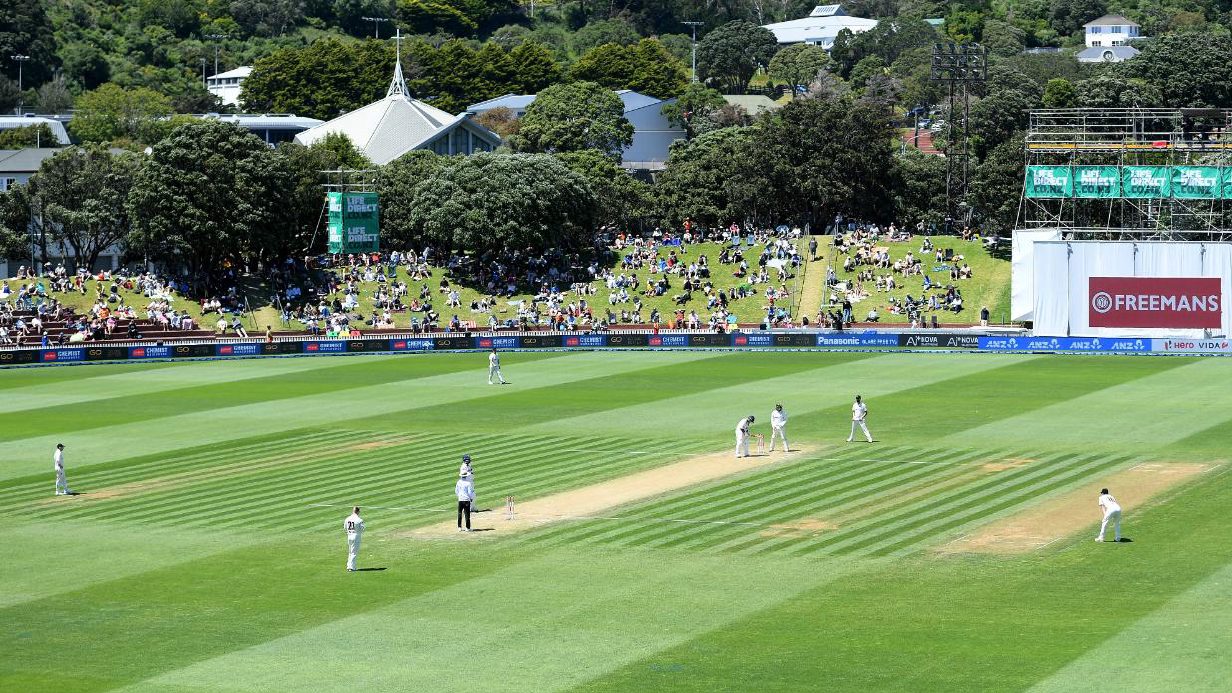
Black Caps, India captains weigh in on Basin Reserve pitch
Curator Tom Davie has acknowledged the new team in charge of the wicket block at the Basin Reserve “were probably just a little bit off” with the pitch for the drawn first test between the Black Caps and India.
It was just the second draw in the last 15 tests at the Basin Reserve, stretching back to 2014 – the other coming against Sri Lanka in 2018 – and the second draw in the 25 tests played in New Zealand this decade – the other coming in the first test against the West Indies last year in Christchurch, where injuries to three Black Caps were a major factor.
India won the toss and chose to bowl last Thursday on a pitch that looked visibly less green than it normally does on the first morning and though they reduced the Black Caps to 52-4 and 70-5, there were few demons in the surface.
After New Zealand recovered to post 368, India batted for the best part of two days in posting 720-9 declared, before the hosts made 239-5 in their second innings, with Daryl Mitchell and Glenn Phillips batting out the final 43 overs on Monday afternoon to secure a draw.
From day two onwards, there was little to no help for seam bowlers and spin bowlers alike, apart from the odd ball that kept low, and batters had a relatively easy time in the middle, with Phllips, KL Rahul and Rishabh Pant joining first-day centurion Henry Nicholls in reaching three figures.
As visiting captain Shubman Gill put it: “It just went flatter and flatter. There were no scallops in the wicket, there was no impact of the overs being bowled on the wicket, or even the days being played, and the wicket just got slower.
“Having seen that, I think it was not a great test wicket, especially if you want results, but having said that, now we talk about results a lot more because of the WTC [World Test Championship]. Before, draws were a lot more common, so people didn’t talk about draws as much.”
The most there was on offer were “a couple of balls, just staying low, but there was no pace in the wicket, so even the balls that were staying low weren’t quick enough to beat the batsmen.”
Home captain Tom Latham was a touch more diplomatic: “It’s probably not your traditional Basin surface that we’ve been presented with over the last few years … where it keeps its pace and bounce. We probably didn’t necessarily see that from day two onwards.”
The Basin Reserve has played host to just two draws in its last 15 tests. Photo: Kerry Marshall / Getty Images
Davie and his team from Mexted Sports Turf took over operations at the Basin in July and he said they “were probably just a little bit off” with their first-up effort, but “overall, pretty happy.”
“I think a test match going five days with a chance of a result is not a bad outcome for your first test.”
A view backed up by the fact that Gill has copped plenty of criticism for waving the white flag with an hour to play on Monday, instead of continuing to chase the one wicket that would have exposed the Black Caps’ tail.
“I don’t think we were far off from creating a really good surface,” Davie added. “We were probably just on the other side of producing a surface that just dried out and changed a little bit too quickly for our liking.
“That’s the beauty of test cricket over five days. There’s a change in the surface, and that unfortunately happened a bit quick and then we probably just didn’t get that deterioration that we would have quite liked in the latter part of the game to maybe force a result.”
Black Caps batters Glenn Phillips and Daryl Mitchell shared in an unbroken sixth-wicket partnership on the final day of the first test against India. Photo: Hagen Hopkins / Getty Images
This year’s five-day test followed two at the Basin that ended inside three days – a Black Caps win over the West Indies last year and a loss to England in 2024.
Four of the other five this decade ended in four days, with the one-run win over England in 2023 finishing in the middle session of the final day.
Davie said pitches in recent years had had “a lot more live green grass and a lot more moisture, probably in the top part going into day one” and that efforts to get that this year had been hampered by bad weather in the lead-up and by good weather once play got going.
“We had a slightly interrupted build-up. That last week was pretty challenging for our prep, to be honest, and we were probably just a little off – 1 or 2% – in our moistures in the top part of the profile.
“We would have liked to have tightened up on that had that weather allowed us and we would have probably had those day one conditions into day two and we’re probably fast forwarding the first innings a little bit.
“We would have probably liked a little bit more in the surface,” Davie added. “I think on reflection, we would definitely have that in the future. We probably just didn’t nail our [moisture content] numbers exactly how we’d like and the really good weather we had in Wellington changed the surface really quickly.”
There will be plenty of interest in the ICC’s rating of this year’s pitch on its four-tier scale – very good, satisfactory, unsatisfactory and unfit.
The Basin has received five very good pitch ratings in its last seven tests, with one average rating, under the old six-tier system, for the pitch in the Black Caps’ win over Sri Lanka in March 2023; and one equivalent satisfactory rating under the new system, for last year’s win over the West Indies.
“It’s test cricket for the cricketers, but it’s also test cricket for the ground staff as well,” Davie said in summation. “We were tested. It was awesome though, to be honest. We were certainly tested, but yeah, we loved it.”
The second test between the Black Caps and India will be played at Hagley Oval in Christchurch from Friday, where the pitch is expected to be more lively for longer.
In last year’s draw, it dried out after two days and the West Indies batted out the final 163.3 overs for a draw, though the Black Caps had lost seamers Matt Henry and Nathan Smith (and wicketkeeper Tom Blundell) to injury.
Rate the Black Caps’ performances
Rate the Players
Score each player out of 10 — the crowd average updates live on each card.