
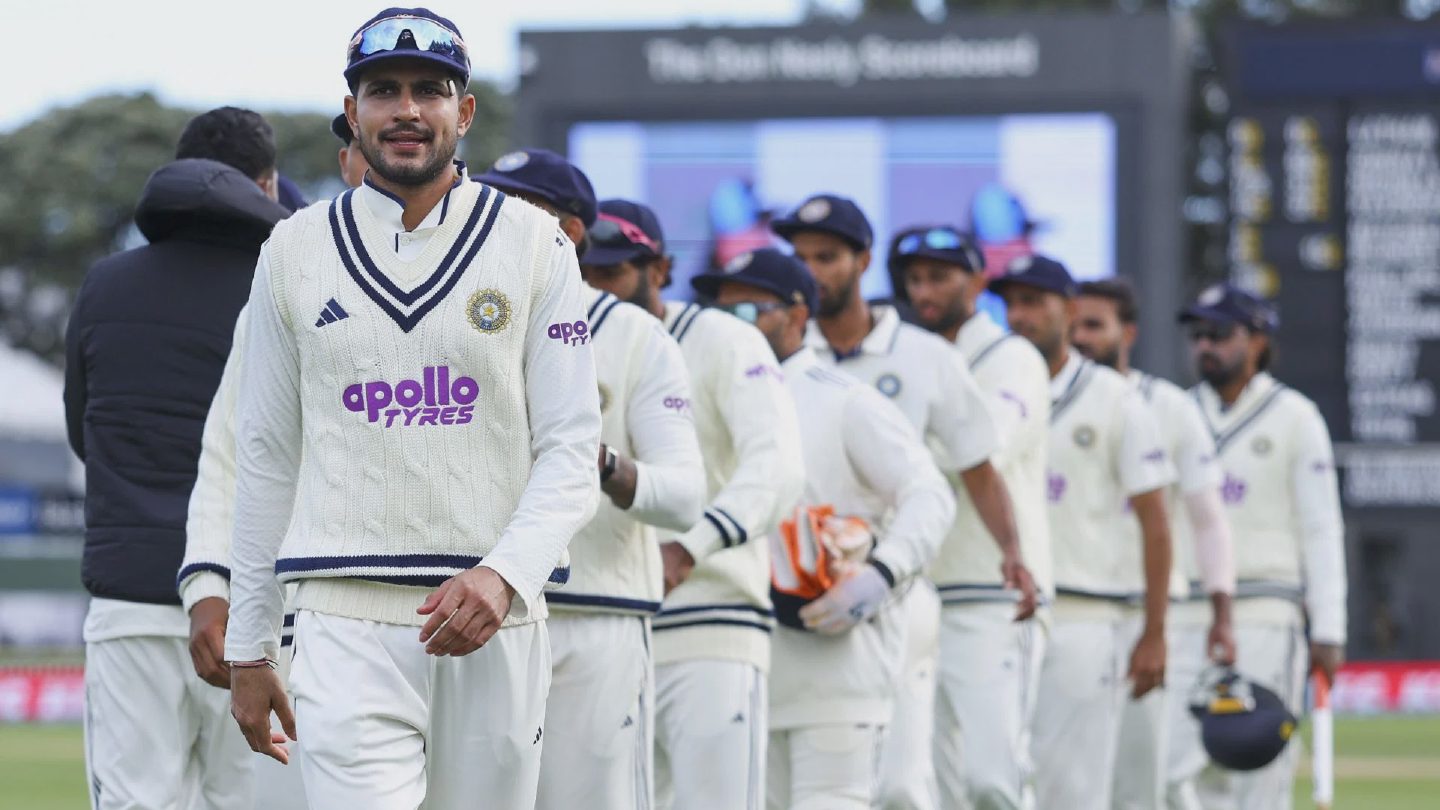
India captain Shubman Gill faced the wrath of fans and pundits after he chose to shake hands with New Zealand to end the first Test as a draw instead of pushing for wickets, with the option of an extra hour of play available. The visitors needed eight wickets on the final day for a 1-0 lead in the series, but managed only three as Glenn Phillips and Daryl Mitchell comfortably saw off the bowling charge till the very end.
New Zealand finished with 239 for 5 in their second innings in 120 overs, 113 runs behind, with Daryl Mitchell on 49 off 186 balls and Glenn Phillips on 26 off 126. India had declared earlier on a historic 720 for 9, with KL Rahul making 136 and Rishabh Pant 128 while Gill fell two short of a hundred.
The majority were appalled by the decision and were not satisfied with the justification Shubman Gill provided after the contest.
“Why did they shake hands with one hour to go? Can’t you take five wickets in one hour? I would have gone for it,” K Srikkanth said on his YouTube channel.
“This is incredible. So 5 wkts have never fallen in the last hour before!!!!!” former England captain Michael Vaughan posted on X.
On that note, let us take a look at the three reasons why Shubman Gill does not deserve relentless criticism for India’s early draw in NZ vs IND 2026 1st Test.
#1 The bowlers’ workload
Although workload should not ideally be a factor in a two-match Test series, it becomes a factor when there is a short turnaround between the two Tests. India bowled 241 overs across New Zealand’s two innings.
Jasprit Bumrah sent down 49 in total, 29 in the first innings and 20 in the second. Prasidh Krishna bowled 45, Akash Deep and Anshul Kamboj 43 each, so all four specialist quicks cleared 40 overs on a surface that gave them nothing.
An Indian pacer has bowled more than 43 overs in a Test only 19 times since 2020, and four instances happened in the same game in Wellington. Shubman Gill tried to make his case by shedding light on the bowlers’ workload on a lifeless pitch, with the priority being the next Test rather than an extra hour of pushing for nothing.
Given that India struggled to create even half a chance as the day progressed, and how comfortable Phillips and Mitchell were blocking away the deliveries without having to worry about lateral movement or inconsistent bounce, it was all the evidence Gill needed to call off the contest instead of going at it for a breakthrough that might have never come and risking fatigue for the next game.
#2 Bowlers were getting absolutely no assistance from the pitch
New Zealand’s second innings lasted 120 overs and produced 239, a rate of 1.99 an over. On the final day, from 119 for 2 overnight, they batted 75 overs for 120 runs and lost three wickets, which were largely the batters’ fault rather than bowlers using the pitch to get something. After tea, New Zealand added 33 in 24 overs without losing a wicket, and with each over they defended more effortlessly as India continued to put in more effort.
A report from Cricbuzz mentions that even New Zealand pacers were turning to broadcasters for tips and help to get at least something out of the wicket. If the hosts are that desperate and helpless, there should be some empathy towards the visitors as well.
Washington Sundar’s off-spin brought 20 wicketless first-innings overs, and Gill turned to part-timers Jaiswal, Jurel and Padikkal in the final session, rather than ask his exhausted fast bowlers to keep going, when there is one more match left to play, and the series is still alive.
While the initial impression of New Zealand venues is heavy wind and green tops, the narrative has shifted with pitches being considerably flatter, especially towards the end of a Test. For instance, in December 2025 at Hagley Oval, New Zealand declared on 466 for 8 and set West Indies 531. West Indies batted 163.3 overs and finished on 457 for 6, the highest fourth-innings total in a five-day Test, with Justin Greaves 202 not out.
Injuries to Matt Henry and Nathan Smith shortened New Zealand’s attack, but West Indies were totally in control and untroubled throughout.
#3 New Zealand had immense batting depth
One particular angle of the widespread criticism is that one wicket would have exposed the tail, and the notion that one could bring two. In most cases, that remains true, but in this case, the chances were highly unlikely. When Tom Blundell fell for 15 in the 77th over, the man walking out was Phillips, who had made 118 in the first innings. Behind him were Nathan Smith, an allrounder at eight, and Kyle Jamieson at nine, who has a Test best of 51 not out.
Even if India had broken the Phillips-Mitchell partnership, the likes of Nathan Smith and Kyle Jamieson, who played out 65 balls in the first innings, would have negotiated the last hour on a flat pitch and tired bowlers with ease.
In the first innings, New Zealand’s last four wickets lasted 27 overs and took them from 286 for 6 to 368. Given India’s struggles to get rid of the lower order, with The Oval Test in 2025 being a rare exception, chances were that the match would have been drawn even with a late breakthrough in Wellington.
Looking for fast live cricket scores? Download CricRocket and get fast score updates, top-notch commentary in-depth match stats & much more! 🚀☄️