
Across the Guardian sportsdesk this week it emerged that a young American colleague didn’t know who Ian Botham was. And why should she? She is young and American. And so the rest of us Brit-splained in five sentences, rehearsed here – and edited to make us sound better than we actually did.
Botham is comfortably among the top five most famous living British sportspeople, certainly among those of a certain age. In 1981 he won (almost) single‑handed (arguably) the greatest Ashes series by bending it to his will. He was on the front pages as well as back in the 1980s, for soft drugs, suspensions and shagging. He is a member of the House of Lords. He is the most English of sports stars, Australians love him, and his grandson James plays rugby union for Wales, which is why we started talking about him.
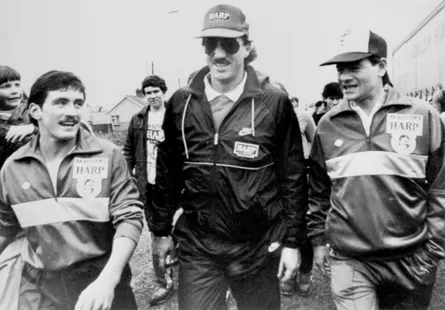
Even that didn’t do him justice. So another five sentences: the deputy digital editor pointed out that we’d somehow omitted the incredible charity walks, raising more than £12m for leukaemia research. Oh, and that he sells wine. The football editor was aghast we hadn’t mentioned his appearances for Scunthorpe United. It turned out that day, Tuesday, was Botham’s 71st birthday. And that same day it was announced that James has become a father, making Ian a great-grandfather.
We all contain multitudes. But this is a lot of multitudes. This is multi-multitudinous.
Like your favourite World Cup (the one you watch when you are 10) or your favourite band (the one you discover when you are 14), different people have their favourite Botham era, or their Botham origin story. As luck would have it I first saw Botham play in real life in that 1981 series, at my first day at a Test match. By this time he was early into the third act of his ridiculous cricket career. There had been the rise through the ranks of Somerset and England, grabbing five-fers, smashing hundreds and breaking records. His name still lines many of Wisden’s best-of tables, fuelled by that first burst. Then there was a 12-Test captaincy, where it turned out – who knew – he couldn’t rally his side to beat West Indies, one of the greatest of all time.
In 1981, as most people know (OK again, most people of a certain age), he was replaced as captain after two ducks at Lord’s by Mike Brearley, who had, in the famous phrase of Rodney Hogg, a degree in people. Botham could easily have missed the third Test at Headingley but instead took six wickets and then, with England following on and 500-1 to win, plundered a wild-eyed 149 not out. Bob Willis won the match with eight for 43 on the final day but somehow is best supporting actor in this story.
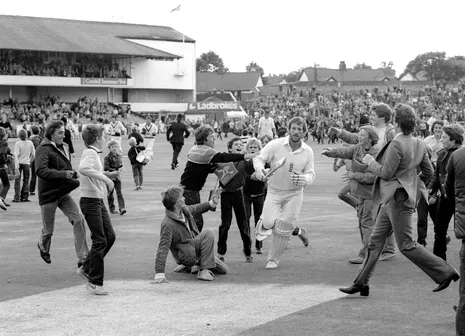
I was at Edgbaston for the next Test for … actually it was a fairly mediocre day in this sensational summer. I remember the beery heave of the crowd as they willed Willis on again, largely in vain. But two days later Botham, charging in like a rhino, won the match from another implausible position with five for one in 28 balls. And then 118 at Old Trafford – a better innings than the 149, thinks Botham – and immortality.
There were other cricketing peaks scaled by Botham, but none of that size, as if there could ever be. Next year I came home from school to find he had scored a double hundred against India. And the summer after that, he was captaining Somerset in a NatWest Trophy semi-final. Somerset at this point were, I think, everyone’s second favourite county team. They had three galacticos – Botham, Viv Richards and Joel Garner – and otherwise a team of mainly journeyman players, with the England international Vic Marks, the future Guardian cricket correspondent, kind of a bridge between the two. Botham rescued Somerset against a powerful Middlesex attack, got to 96 not out and then blocked the final over so his side could win on fewest wickets lost. It was high-stakes, live-on-BBC-TV drama. Different times.
And so it goes. More successes. More failures. More comebacks. The outswing lost, the inswing slowing. A bid for Hollywood fame, the blunders and boorishness. Three Shredded Wheat. The “who writes your scripts” line from Graham Gooch in 1986 when Botham, on his first ball after a ban for taking marijuana, equalled the record for the most Test wickets. The falling out with Somerset. Then Worcestershire, Durham … and retirement, battered by injuries and wearied by toil in a world with no central contracts.
Slightly younger people might remember Botham now as, like Willis, a slightly harrumphing Sky commentator. Or as David Brent’s lodestar in The Office. Others may think of him as an old-fashioned nationalist with obvious opinions – “It doesn’t matter mate. We won,” he said when Marks gingerly raised Brexit in an interview for Botham’s 65th birthday. It’s worth recording that Botham, unlike many storied England players of his generation, never took the blood money to play in apartheid South Africa. Still, I suspect there’s a few Guardian readers who would be reluctant to dine across the divide with Lord Botham. But when it comes to him or, say, Philip Larkin or Mark E Smith, you are reminded that politics isn’t everything. It is there, very present, but not exactly the point either.
Earlier this month James Botham was player of the match when Wales defeated the All Blacks for the first time since 1953. In classic, chip-off-the-old-block fashion, James’s father, Liam, – a former cricketer, rugby union and rugby league player himself – piled into the Wales coach, Steve Tandy, when James was dropped for the next match against Australia. Maybe one day, in some places, Ian may be best known as James’s grandad, or even James’s daughter’s great‑grandad. That will require both stellar, gravity‑defying lives and dwindling memories.
Who is Ian Botham? It depends on who you ask. And perhaps it depends on who you are. But now, four rungs down the family tree, he’s had the kind of life that still looks awe-inspiring from pretty much every angle.