
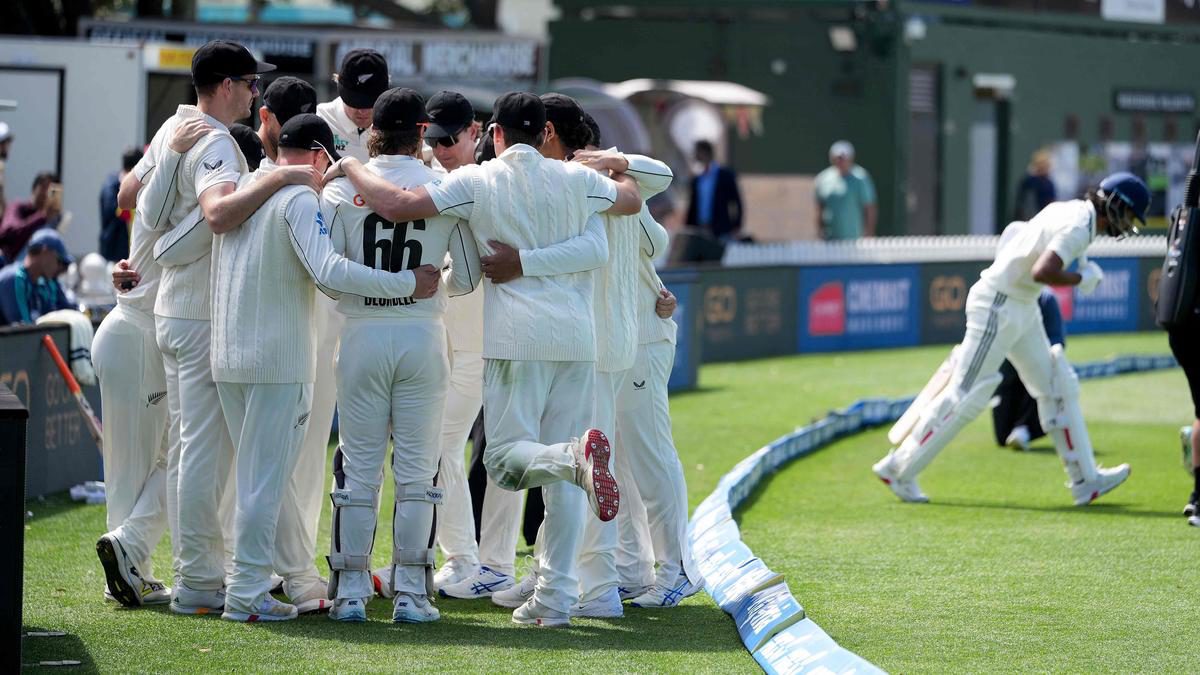
New Zealand and India are playing the second and final Test of their two-match series at Hagley Oval in Christchurch. The first Test in Wellington ended in a draw. The series is part of the World Test Championship, where every point matters. The second day belonged to New Zealand. India finished on 116 for six, still 240 runs behind. Yet in the end-of-day discussion on the broadcast, the talk drifted away from the scoreboard.
Veteran commentators Ian Smith and Sunil Gavaskar had a different grievance. It was about the drinks. Not the scheduled breaks. Their complaint was the steady trickle of bottles to the boundary rope. A fast bowler finishes his over and walks to fine leg. A drink is waiting for him. Nobody asks the umpire.
Smith, the former New Zealand wicketkeeper, framed it as a question of value. “People pay to get in to watch you,” he said. “You’ve got to give them value for money.” He blamed the players and the captains. He did not spare the officials either. “I don’t see enough proactiveness from the elite panel of umpires around the world to force the issue.”
In his day, Smith recalled, nobody asked for a drink before the first hour was gone. The next refreshment was lunch. The body learned to cope. Fatigue was part of the contest. A patient batter could wear a bowler down. Not any more. “He’s getting refreshment, he’s getting sustenance almost at the end of every over,” Smith said. The public, he felt, was being short-changed.
Gavaskar was even less patient. “You need action on this front,” he said. “It’s no point Smith and me talking about it.” His answer was to make the umpires the gatekeepers again. “The moment a player enters the field without the permission of the umpires, the umpire should say, ‘Get going. No, don’t get onto the field.’”
Gavaskar has fought this battle before. In 1992, India toured South Africa for the first time. As Gavaskar tells it, Jagmohan Dalmiya asked him to negotiate the playing conditions. Ali Bacher proposed drinks at the boundary. Gavaskar refused. “Cricket is a game of stamina,” he told Bacher. “If the batters are not getting a drink after every over, a bowler should not get a drink.”
That is the heart of the matter. Why should the bowler on the boundary rope enjoy a privilege that the batter does not? The batter is toiling just as hard in the middle. He may have run between the wickets multiple times in an over. Nobody brings him a bottle.
Neither man is against hydration. Both accept that extreme heat calls for extra drinks. Gavaskar’s point is about who decides. “Extreme heat, extreme circumstances, leave it to the umpire,” he said. “But ask the umpires.”
Sports medicine supports that distinction. In 1993, Australian researchers reported in the International Journal of Sports Medicine that three fast bowlers lost an average of 4.3 per cent of their body mass after two sessions on a hot day. The authors said that was enough to impair performance. They suggested letting players drink as desired when conditions are extreme.
A 2016 study tested 30 cricketers over two hours of training in hot, humid conditions. With fluids restricted, they lost 3.7 per cent of their body mass. With fluids provided, the loss was 0.9 per cent. In the restricted trial, the fast bowlers’ accuracy of line fell by about 20 per cent. The fielders’ sidearm throwing accuracy fell by about 22 per cent. Keeping losses within one per cent prevented any significant decline.
Then there is the batter. In 2018, Australian researchers had 38 First-Class cricketers swallow temperature sensors during six four-day matches. Core temperature rose by about one degree Celsius for every two hours of batting. Batters showed greater rises than other players.
The evidence supports preventing serious dehydration in harsh heat. It does not show that a bowler needs a drink after every over in ordinary conditions. And it suggests the batter needs protection at least as much as the bowler.
So what does the rulebook say? Clause 11.8 of the ICC Test playing conditions schedules one drinks interval per session. Each should last no more than four minutes. In extreme heat, the umpires may allow more. An individual player may also be given a drink on the boundary edge, or on the field at the fall of a wicket, provided no playing time is wasted.
Any other drink needs the umpires’ permission. So the bowler at fine leg is within his rights, as long as play is not held up. That explains the silence of the umpires. The rule itself hands the privilege to the fielder.
The rules meant to police wasted time are forgiving too. The over-rate target is 15 overs an hour, or 90 in a day, with an extra half hour to catch up. Officials then grant allowances. Each drinks break is worth four minutes. Each wicket is worth two. A team is fined five per cent of its match fee for every over short. The real sting is one World Test Championship point for every over short.
Christchurch knows that well. Two years ago, at this very ground, England and New Zealand were each docked three points.
The ICC has also brought a stop clock into Tests to curb delays between overs. The fielding side must be ready to start each over within 60 seconds. After two warnings, each breach costs five runs. It is a start.
Gavaskar had one last word for the modern player. Today’s cricketers, he said, are supposed to be far fitter than his generation. “So show that fitness.”
All of this is only a diagnosis. The treatment and follow up has to come from the ICC. It can put the boundary drink back under the umpire’s control. It can measure how much time these drinks really cost. Above all, it can treat batter and bowler alike. People pay to watch cricket. They deserve their money’s worth.
Published on Nov 29, 2026